How China's Geely Beat Toyota, BMW, Ford and Everyone Else
driving 4 answers
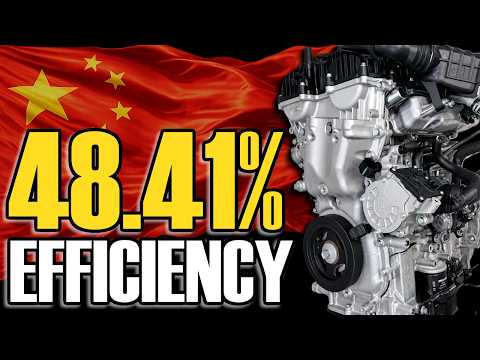
Geely 1.5IHEV: 48.41% thermal efficiency
Geely's mass-produced 1.5IHEV engine is reported to reach a verified '48.41% thermal efficiency' and powers the current 'Guinness World Record' holder for the most fuel-efficient mass-produced car. The speaker contrasts that with 'Toyota' at 41% and 'Nissan' at 42% (noting the Nissan engine only acts as a generator), and emphasizes the headline gap of '7.4%'.
Mechanically the engine is extremely undersquared: published data and calculations give a bore of '70 mm' and a stroke of '97, 0.4 mm' (bore:stroke '1.39 to 1'). The speaker explains undersquare geometry reduces piston-ring blow-by area, improves air–fuel mixing in a smaller combustion cross-section, increases extractable work per stroke, and inherently favors efficiency over high-RPM power.
Combustion and friction measures cited include a 'fire tornado combustion system' with a 'duckbill intake' (an optimized intake shape to increase tumble/velocity), '500 bar' direct injection, a '15.5 to one' compression ratio, laser clad valve seats, DLC (diamond-like coatings), and advanced surface machining. Many of these elements are noted as similar to modern 'Toyota dynamic force' engines, so the speaker argues they cannot alone explain the 7.4% advantage.
The decisive factor, per the speaker, is a 'deep Miller cycle'—a very late intake-valve closing that produces an extreme Atkinson/Miller effect. Because that timing severely reduces on-cylinder charge and makes the engine weak solo, Geely pairs it with large electric motors and batteries so the vehicle is electric-centric: the electric motor is primary and the engine 'assists the motor' (the engine would be unusable without hybrid support). This system choice—what the speaker calls an 'engineified EV'—lets the engine operate at much higher terminal efficiency than a conventional hybrid where the engine is the primary mover.
Trade-offs are highlighted: poor solo-engine performance when batteries are depleted causes sudden power loss on long climbs, which Geely mitigates with an 'AI power cloud system' to manage battery state-of-charge. The speaker's conclusion: the record is real but arises from a system-level decision ('bigger batteries and motors') enabling a very deep Miller/Atkinson strategy, rather than a single revolutionary combustion invention. It's an important milestone showing Chinese OEMs have closed major gaps in engine technology, but it carries clear usability compromises.