How Car Mechanics Make Money
Tony Talks Business
The flat-rate book time system (Mitchell)
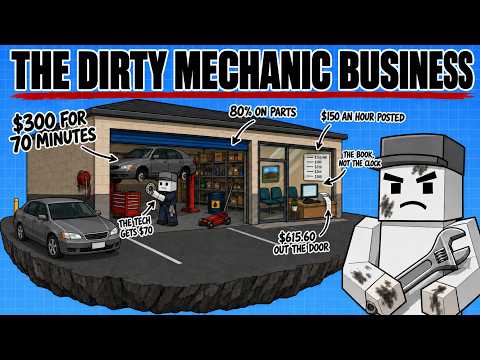
The video follows one ordinary brake job to show where the money goes: the U.S. auto-repair market is an $89 billion business across roughly 300,000 shops, and most margin lives in pricing systems, not technician time. Labor is priced from a manufacturer labor guide (Mitchell) as 'book time' or flat rate: a two-hour job priced at $150/hr produces a $300 labor charge even if the technician finishes in 70 minutes. The technician is typically paid on the same book (paid two hours on a $35/hr flat-rate gives $70), so the shop keeps the difference and re-sells the recovered bay time (the shop tracks 'effective labor rate', e.g. posted $150 can behave like $250).
Parts use a parts matrix that marks up cheap, hard-to-compare items heavily and keeps big-ticket parts relatively lean; the example job shows parts cost $140, invoiced $252 (80% markup). A shop-supplies line ($18) and an oil-change 'access' model turn cheap services into a sales channel: the free multi-point inspection and $39.99 oil change buy the shop access to the car on a lift and a captive customer. Digital inspections (photos/videos) dramatically reduce trust friction and can raise repair-order values (one operator rose from $264 to $568 on average; others report up to +50%).
Dealerships run on this too: franchise fixed operations make ~13% of revenue but roughly half of gross profit, so new-car sales act as a subscription to service. Right-to-repair developments matter materially — Massachusetts voters passed a law in 2020, manufacturers lost court challenges by Feb 2025, and by early 2026 their trade group conceded compliance was possible.
Technicians feel distorted incentives: flat-rate pay rewards speed and volume but pays little for hard diagnosis. Median technician wage about $49,000; toolsets cost tens of thousands; the industry needs ~70,000 new techs/year but produces ~50,000 (shortfall ~20,000). EVs cut routine maintenance dramatically (gas cars $700–$1,300/yr vs EV $200–$350/yr) and could reduce service revenue by up to 30%, shifting work toward fewer, higher-cost specialists.
Bottom line: the money is in book time, parts matrices, access-selling (inspections/oil changes) and information asymmetry under the car. Good shops solve trust with photos; the rest rely on systems that convert hidden knowledge into margin.