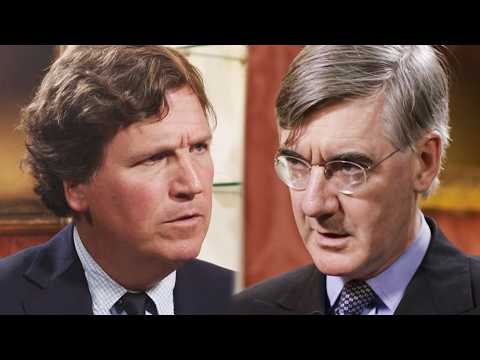
Tucker interviews smart person, INSTANT DISASTER
David Pakman
Tucker Carlson challenged by Jacob Rees-Mogg on Russia and Ukraine
The speaker argues that Tucker Carlson’s interview with former British conservative cabinet minister Jacob Rees-Mogg shows what happens when Carlson’s assertions meet an informed challenge. Carlson claimed Russia had a much larger economy than Britain; Rees-Mogg replied that Russia’s total GDP is smaller despite its larger population and resources. Citing the World Bank, the speaker puts Britain’s economy at about four trillion and Russia’s at about 2.6 trillion—making Britain’s more than 50% bigger. Carlson disputed whether GDP alone measures economic strength, but Rees-Mogg attributed Russia’s weak economic performance to corruption and poor use of its resources.
Their dispute then turned to Ukraine’s territorial integrity. Rees-Mogg pressed Carlson on the agreement under which Ukraine gave up its nuclear weapons and received assurances from the United States, Russia and the United Kingdom. Carlson raised subsequent arrangements and an alleged verbal promise that NATO would not expand toward Russia. The speaker grants that Western officials discussed eastward expansion with Soviet leaders in 1990: James Baker used the phrase 'not one inch eastward' while negotiating with Gorbachev over German reunification. But, the speaker says, those talks produced no treaty barring Poland, the Baltic states or other countries from later joining NATO.
The speaker also rejects the premise that NATO had never bordered Russia: founding member Norway shared a 200 kilometer border with the Soviet Union in 1949 and shares it with Russia today. After the Soviet Union collapsed, Russia repeatedly recognized Ukraine’s sovereignty and signed the Budapest Memorandum in 94, when Ukraine agreed to surrender its inherited nuclear arsenal. In the speaker’s view, arguments about NATO expansion do not justify Vladimir Putin’s invasion or make it a defensive war. Rees-Mogg also accused Carlson of verging on defending Hitler during a separate World War II exchange. The broader conclusion is that Carlson’s confident, sweeping claims fare poorly when a guest is willing and able to contest them.