"Pi" as a Response to Complexity and Fragility in Coding Agent Harnesses: Mario's Tragedy in Three Acts
Mario details his journey developing Pi, an extensible coding agent harness, motivated by frustrations with Cloud Code and other agent harnesses. Cloud Code initially fit his workflow (started April 2025) but became unreliable and unpredictable due to frequent changes, lack of observability, minimal extensibility, and imposed system reminders confusing the model. The introduction of excess features led to bugs and instability, disrupting Mario's development. OpenCode offered more reliability but had context handling flaws such as aggressive pruning ('lobotomizes the model'), automatic error injection confusing editing flows, and insecure defaults ("Course headers are set in such a way that any website you open in your browser can now access your open code server"), prompting Mario's pursuit of a better harness.
He highlights TerminalBench as an unexpectedly high-performing harness—"no file tools, no subagents," yet top of the leaderboard as of December 2025, demonstrating that minimalism outperformed proprietary or feature-laden harnesses. Mario's thesis: agent harnesses are in an unstable, experimental phase, and what is needed are "self-modifying malleable agents"—tools that adapt to the user instead of the reverse. Pi embodies this philosophy: minimal defaults, full-extensibility via TypeScript modules, hot-reloading, and direct API exposure for tool and workflow customization. Extensions are easily created—often written by Pi itself given user specifications—and shared via npm or GitHub, avoiding siloed marketplaces.
Act 2 addresses the open source landscape—OSS in the "Age of Plankers." When Pi was integrated as Open Claw's core, Mario experienced a flood of low-quality pull requests from automated instances. He countered with filtering, labeling, and selective OSS tracker closures to regain control. These practices partially mitigated the burden but raised sustainability concerns.
In Act 3, Mario cautions against uncritical agent-driven development. He observes products built "100% by agents" quickly degrade, and agent systems suffer 'learned complexity'—drawing from vast, mostly low-quality internet code—introducing local decisions, excessive abstractions, and duplication the agents cannot manage or review at scale. Humans, though fallible, feel pain and ultimately address code rot, unlike agents that persist in adding complexity. Mario sets forth criteria for safe agent tasks: well-scoped, modular, evaluable by function, iterative on non-critical or boring work, and user issue reproducibility. For critical code, he insists on human review and hands-on coding, arguing that direct friction builds system understanding and learning.
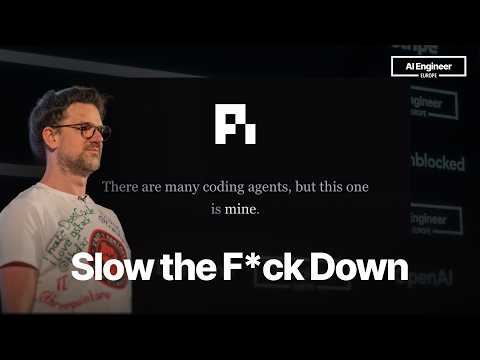
Closing, Mario’s call: "Slow the fuck down. Learn to say no." Use agents to polish essential features; discard what does not matter. For critical tasks, humans must engage deeply, not delegate decision-making to agents that lack judgment. OSS sustainability, careful harness design, and disciplined human oversight are essential amid accelerating agent-driven software development.