They Only Have One Option to Lower Rates
Heresy Financial
The US government’s three paths to lower interest rates
The speaker argues that multi-decade-high interest rates strain households, businesses and federal finances. He sees three paths down: change government policy, endure a severe downturn, or create money to buy US Treasuries. He considers a mix of policy changes and money creation most likely—and warns that artificially lowering rates would raise prices and devalue the dollar.
Government policy: Fiscal-year-to-date spending of $6.8 trillion against $4.8 trillion in taxes has required borrowing just under $2 trillion. The speaker says issuing more Treasuries depresses their prices and raises yields. Spending cuts are the strongest remedy, but he sees little prospect of them after DOGE produced no material change. Higher taxes could reduce borrowing, yet he argues federal revenue has stayed around 15 to 18% of GDP for about 80 years, regardless of rates; at about 17% now, he expects little additional revenue. He also identifies regulation, tariffs and wars that raise oil or other input costs as possible levers. He points to a rise in the US 10 year treasury yield since February but does not name a specific cause [inferred from chart reference].
Economic hardship: Recessions in 2020 and during the great financial crisis coincided with plunging rates: investors sought safer bonds, while weaker growth reduced inflation expectations. But the speaker doubts a major forced sell-off is imminent. Real median household income recovered its 2019 peak only in 2024 after a 2019 through 2022 decline [inferred from historical-data reference]. Household debt relative to assets is, he says, at its lowest since 1970 [inferred from chart reference]. Though national credit-card debt is about $1.4 trillion, the average balance among accounts carrying debt is $11,000 versus an inflation-adjusted $13,000 in quarter four of 2008; 43% of accounts and about 49% of households carry a balance, leaving 51% of households without one.
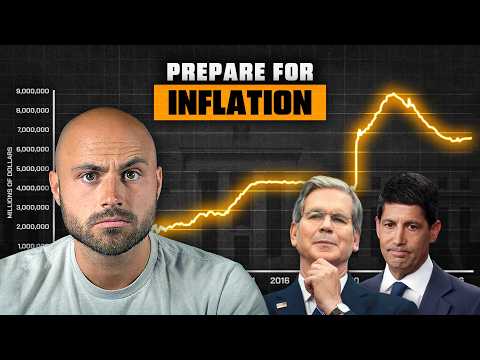
Treasury purchases: The Federal Reserve could expand quantitative easing (QE), which buys Treasuries with newly created money. The speaker says its current purchases are small and confined to short-term debt; he cites Kevin Warsh’s opposition to routine QE outside crises. Yield curve control would instead buy whatever amount is needed to peg yields—for example, perhaps $300 billion or $3 trillion to target a 3% 10-year yield—making it less likely still. His likelier combination is a Middle East resolution that lowers oil prices before the midterms, looser bank rules permitting more Treasury purchases, and more short-term Fed QE. Without lower rates, he concludes, government borrowing costs will become untenable.