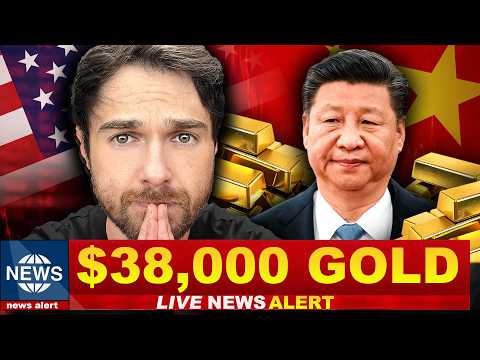
China Is Preparing For $38,000 Gold
Andrei Jikh
China's Gold Accumulation and the Global Move Toward a Neutral Reserve Asset
In a historic shift, China’s largest exchange-traded fund (ETF) is now the Juan Yifu Gold ETF ($13 billion), surpassing the country's equivalent of the S&P 500 ($12 billion in stocks), marking ordinary Chinese retail investors' pivot from equities to gold. This trend coincides with a recent drop in gold prices (from around $5,600 to below $4,000 an ounce, nearly 30%), but both retail and institutional buyers accelerated purchases: The People’s Bank of China acquired gold for the 20th consecutive month—the longest streak since at least 2015—with nearly 15 tons bought in June and 700 tons of imports in the first five months of 2024 (over 14,000 tons since 2015). World central banks collectively bought 41 tons net in May, with countries like Poland, Uzbekistan, and Kazakhstan increasing reserves.
On July 24, four major Chinese banks will end retail paper-gold trading, favoring real, physical gold ownership. The video posits that this is not isolated to China: The US Treasury Secretary published a Wall Street Journal op-ed referencing 'Hamiltonian economics,' advocating a return to Alexander Hamilton’s plan (tariffs, subsidies, and protection for 'infant industries') designed to rebuild US manufacturing. The speaker highlights that throughout history, empires transition from industrialization (protection and growth) to financialization (reliance on paper markets, share buybacks, cheap imports, and loss of industrial base), citing the British Empire's demise after abandoning protectionist policies, and notes the same cycle underway in the US since the dollar left the gold standard in 1971.
Recent speeches by US trade officials Jameson Greer and Treasury Secretary Scott Bessent outline five principles for a new economic statecraft, emphasizing national production and reciprocal openness. Per Lou Grumman (FFTT), the US cannot simultaneously rebuild factories, protect Main Street, and maintain a strong dollar—only two can coexist, with the likely sacrifice being dollar strength. Grumman further argues the dollar's adjustment may be absorbed via gold, the only asset not tied to single-country fiat and capable of absorbing such rebalancing.
China began advocating for a neutral reserve asset in 2009: their central bank’s governor called for an international currency disconnected from national credit-based money, referencing John Maynard Keynes’s Bancor idea from 1944. Multiple US and international officials—Robert Zoellick (World Bank, 2010), Ken Rogoff (IMF, 2016), Greer, and Bessent—all now call for considering gold as the world’s monetary anchor. The speaker cites Grumman’s calculation: If China settled its $1.2 trillion trade surplus in gold (based on 940 tons imports), the balancing price would be ~$38,000 per ounce.
Evidence of this rebalancing includes sustained central bank gold accumulation, China's drive for real gold ownership, and surging US gold exports to China. The speaker presents two possible outcomes: (1) reindustrialization fails, leading to financial system collapse and gold prices spiking as paper currencies break; (2) successful transition, with trade gradually balanced using gold as a neutral asset, as both China (2009) and US officials (2024) envision. Either way, the speaker expects capital rotation from financial assets to commodities and infrastructure, with gold outperforming. While the S&P 500 is up 161% in dollars since 2018, it is down 15% measured in gold; treasury bonds are down 31% in dollars and 78% in gold. Gold miners outperform. The transition is considered slow, potentially spanning a decade, with the caution that 'there is a difference between being right on the direction and being right on the timing of when to buy.'