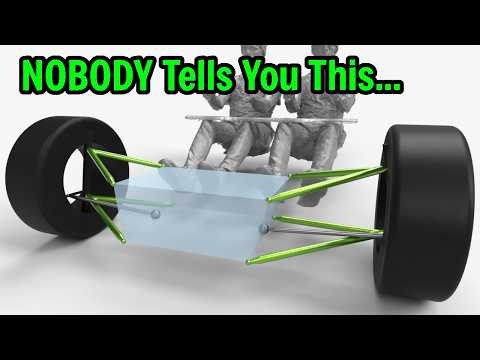
What Everyone is Missing About Suspension
Crusty Creations
Motorcycle powered car: chosen roll centers and the load-transfer logic
The speaker frames suspension design around one immutable fact: for a given center of gravity, track width and wheelbase set the total load transfer, and load transfer "is essentially bad" because tire coefficient of friction falls with vertical load. Suspension cannot change the total transferred load but can change how quickly and through which elements that load moves—either geometrically (through control-arm kinematics, i.e. roll centers) or elastically (through springs and anti-roll bars).
Key trade-offs are enumerated. High roll centers increase geometric load transfer (fast transfer, less body roll, better turn-in responsiveness, reduced camber loss) but create high jacking force and risk shock-loading tires and sensitivity to jerk. Low roll centers force elastic transfer (slower, more forgiving, tunable via dampers, less jacking force) but require stiffer anti-roll elements and can reduce true wheel independence and induce initial camber loss on turn-in.
The speaker stresses front/rear interaction: shifting roll stiffness changes where load transfer happens and thus understeer/oversteer balance. Because front tires see lateral force almost immediately on turn-in, the recommendation is typically to bias geometric load transfer to the rear and make the front more elastic to improve turn-in, then use elastic transfer mid-corner to balance a rear-heavy car.
No universal numbers are promised, but the speaker documents his design decisions for a specific project: a "motorcycle powered car" with track width 60 inches, center of gravity ~15 inches, weight distribution 42 front / 58 rear. He chose rear roll center = 3.1 inches and front roll center = 1.8 inches, giving rear jacking ≈ 10.3% and front jacking ≈ 6%, and geometric load-transfer ~20.7% rear / 12% front. He used Onshape (free → Onshape Professional) for CAD; notes Optimum G exists but was out of budget. The overarching recommendation: design for adjustability, test on track, and tune geometric vs elastic transfer to time turn-in versus mid-corner behavior rather than chasing a single "correct" roll-center value.