The Evolution and Economics of Automotive AC Refrigerants: Patents, Efficiency, and Environmental Impact
Automotive AC refrigerants have evolved significantly from the original R12 to today's 1234 YF, resulting in increased costs for repairs and environmental improvements. Early systems before R12 used highly toxic chemicals like ammonia, sulfur dioxide, and methylene chloride, which sometimes proved lethal upon leakage. Introduced in 1930, R12 was valued for its non-toxicity, non-flammability, chemical stability, and refrigeration efficacy, tolerating engineering imperfections and operating with mineral oil.
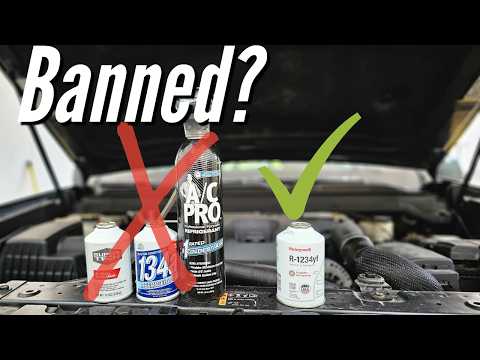
Despite its performance, R12 contained chlorine, leading to ozone depletion under UV exposure and the Montreal Protocol ban (signed 1987, enforced in the US starting 1995). DuPont responded by developing R134A, introduced in the early 1990s and fully replacing R12 by 1995. R134A, free of chlorine, provided good cooling and affordability, yet its heat removal efficiency was about 10% lower and it operated at slightly higher pressures; it also absorbed more water due to PAG oil, reducing cooling potential. R134A’s global warming potential (GWP) was 1,430—releasing 16 ounces equated to the atmospheric heat of 1,430 pounds of CO2. R12’s GWP was even higher at 10,400.
To address GWP concerns, industry developed 1234 YF, phased in from 2011 to 2021. In laboratory testing, 1234 YF offers several percent greater efficiency than R134A, but real-world differences are negligible. The key improvement is environmental: it breaks down in the atmosphere within about 10 days (compared to 14 years for R134A and 100 years for R12), resulting in a GWP of 4—dramatically lower than its predecessors. 1234 YF uses its own dedicated PAG oil; mixing with R134A PAG oil causes system sludging and failure. It is slightly flammable but requires a strong spark to ignite and produces a 'lazy' flame.
The 1234 YF formula is patented jointly by Honeywell and Camores, a DuPont spinoff. Only these companies can sell pure 1234 YF without additives; other brands must include stop leak or similar to avoid patent infringement. The patent-protected status contributes to the current high price—about $45 per can. The speaker speculates that, as happened when R134A patents expired (2011–2015), a new refrigerant may emerge around 2030 when 1234 YF patents expire. This could be marketed as PFAS-free—since 1234 YF contains a PFAS compound linked to Teflon—and regulated for exclusivity.
An alternative is CO2 (R744), which offers GWP of 1, no PFAS, and no ozone impact but requires AC systems robust enough to withstand pressures five times higher than current standards, raising vehicle costs. CO2 cannot be patented, so would not benefit DuPont or similar companies. Ultimately, today's expensive, environmentally friendlier refrigerants are the result of legislative, patent, and technical transitions in response to environmental disasters and corporate interests.